



When global health emergencies hit, one product instantly becomes mission-critical: the N95 mask. Behind every high-quality N95 respirator is advanced N95 mask production equipment—a combination of automation, precision engineering, and strict quality control.
Whether you are an investor, manufacturer, or healthcare supplier, understanding how N95 mask machines work can save money, boost output, and ensure compliance. In this guide, we’ll break down how N95 mask production equipment works, answer the most common questions, and reveal practical insights you can use today.
Let’s dive into the machines that protect millions of lives every day.
1. What Is N95 Mask Production Equipment?
N95 mask production equipment refers to a fully automated or semi-automated production line designed to manufacture N95 respirators. These systems integrate:Nonwoven fabric feedingUltrasonic welding
Nose bridge insertion
Ear loop or headband attachmentMask shaping and cutting
Inspection and packagingA complete line can produce 35–45masks per minute, depending on configuration and automation level.
Fun fact: During peak demand, modern N95 production lines helped increase global output by over 300% between 2020 and 2022.
2. How Does an N95 Mask Machine Work?
The process is beautifully simple yet technologically powerful:
Material feeding – Melt-blown and spunbond nonwoven fabrics are layered.
Ultrasonic welding – Fabric layers are sealed without glue.
Nose clip insertion – Ensures a tight facial seal.
Mask forming – Cup or folded shape is molded.
Strap welding – Headbands or ear loops are attached.
Cutting & stacking – Masks are separated and counted.
Each step must be synchronized perfectly. Any misalignment can affect filtration efficiency or fit.
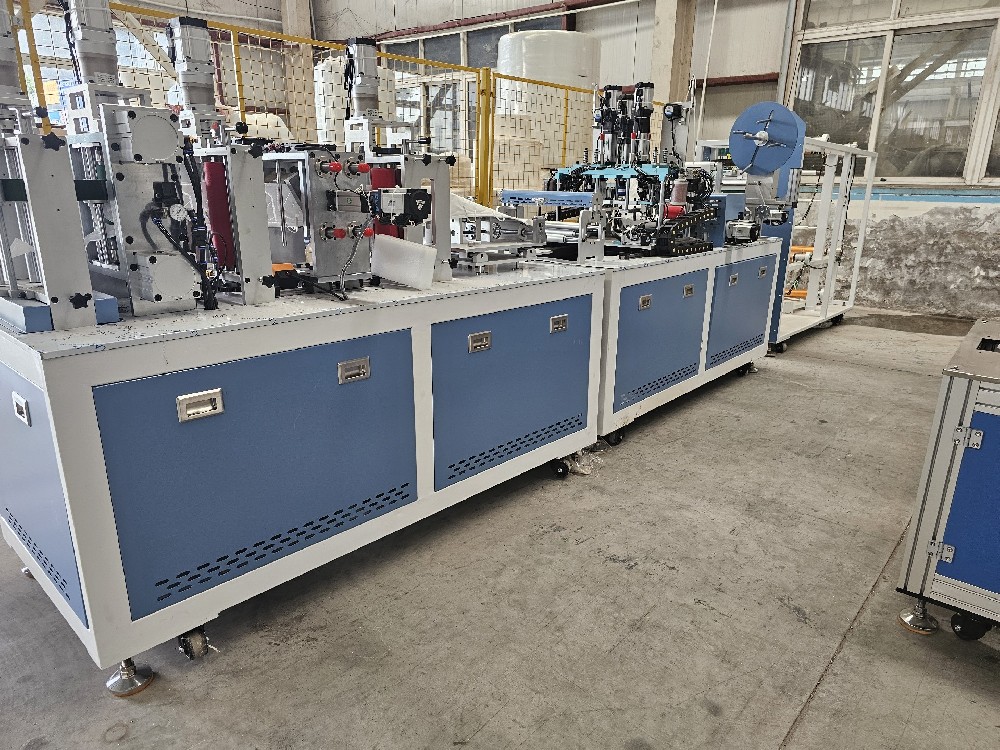
N95 Mask Production Equipment
3. What Materials Are Used in N95 Masks?
N95 mask production equipment processes multiple layers:
Spunbond nonwoven (outer & inner layers)
Melt-blown fabric (filtration layer)
Aluminum nose clip
Elastic headbands
The melt-blown layer is the heart of filtration. One gram of melt-blown fabric can contain billions of microfibers that trap particles electrostatically.
4. What Certifications Must the Equipment Support?
To sell N95 masks legally, your equipment must help produce masks that meet:
NIOSH (US)
CE (EU)
ISO 13485 (medical manufacturing)
Good equipment ensures:
Consistent filtration efficiency
Stable mask shape
Uniform welding strength
In short, your machine doesn’t just make masks—it protects your brand reputation.
5. Can N95 Production Equipment Be Customized?
Absolutely. Modern manufacturers offer:
Different mask shapes (cup, duckbill, folded)
Multi-layer fabric options
Automatic visual inspection
Inline packaging
Remote monitoring
Customization helps businesses scale faster and adapt to market trends.
6. What Are the Biggest Challenges in N95 Mask Manufacturing?
The top three challenges are:
Material quality fluctuations
Maintaining filtration efficiency
Ensuring airtight sealing
Smart equipment solves this with:
Tension control systems
Ultrasonic power regulation
Real-time fault detection
Automation reduces human error by up to 70% compared to manual production.
7. Why Automation Is the Future of N95 Mask Production
Automated N95 mask production equipment offers:
Lower labor costs
Higher consistency
Faster production
Reduced contamination risk
Factories that upgraded to automated lines saw productivity increase by 40–60% while cutting waste by nearly 30%.
N95 mask production equipment is more than machinery—it is a frontline defense system for global health. From ultrasonic welding to melt-blown filtration, every detail matters.
If you want to compete in today’s protective equipment market, you need speed, precision, and reliability. With the right production line, you don’t just make masks—you build trust, safety, and resilience.
The future belongs to manufacturers who invest smartly, automate boldly, and meet the world’s need for protection with confidence.
Email:[email protected]
Add: Henan Communication Industry Area, Jingbei 3rd Road, Zhengzhou, Henan, China