



When summer temperatures soar, people naturally look for quick ways to cool down. From outdoor workers and athletes to travelers and commuters, cooling wipes have become a must-have product during hot weather. These refreshing wipes provide instant relief by lowering skin temperature and delivering a soothing sensation within seconds.
But have you ever wondered how cooling wipes are actually made? Behind every pack lies a highly automated production system known as a cooling wipe machine. This advanced equipment combines precision engineering, liquid formulation, and hygienic packaging technology to produce thousands of cooling wipes every hour.
Why are cooling wipes so popular?
Cooling wipes are specially designed wipes containing cooling ingredients such as menthol, cooling agents, and refreshing fragrances. They provide an immediate cooling sensation when applied to the skin.
Market data shows that demand is growing rapidly:
The global wipes market is projected to exceed $30 billion by 2027.
Cooling wipes are one of the fastest-growing market segments, particularly in Asia and the Middle East.
Outdoor sports, the construction industry, and tourism are the main drivers of this growth.
To meet this huge demand, manufacturers rely on fully automated cooling wipe production equipment capable of producing thousands of wipes per minute while maintaining strict hygiene standards.
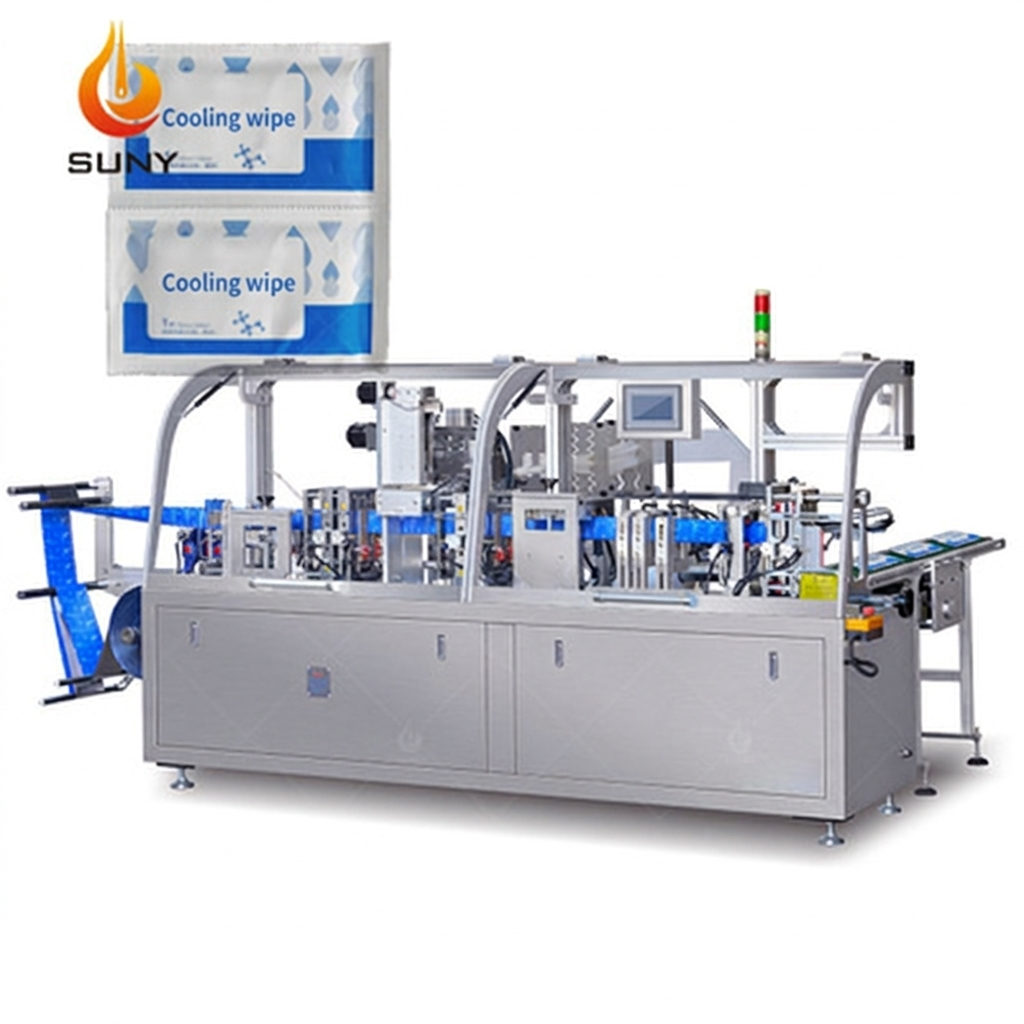
How a Cooling Wipe Machine Produces Cooling Wipes
1. Nonwoven Fabric Feeding
The process begins with a roll of nonwoven fabric, the base material used to create wipes.
A cooling wipe machine automatically:
Unwinds the large fabric roll
Controls tension for smooth feeding
Guides the fabric into the production line
Nonwoven fabrics are chosen because they are soft, absorbent, durable, and skin-friendly.
2. Cooling Solution Preparation
The refreshing effect comes from a specially formulated cooling liquid solution.
Typical ingredients include:
Menthol or cooling agents
Purified water
Skin-friendly preservatives
Aloe or vitamin extracts
Light fragrance
The cooling wipe machine uses a precision dosing system to ensure the correct formula ratio for consistent cooling performance.
3. Liquid Saturation System
Next, the nonwoven fabric passes through a liquid impregnation system.
Here the machine:
Evenly distributes the cooling solution
Controls the exact moisture level
Prevents over-saturation
This step is crucial because too much liquid can cause leakage, while too little reduces the cooling effect.
4. Folding and Cutting
After saturation, the fabric enters the folding system, where it is shaped into individual wipes.
The machine can produce multiple folding types, including:
Z-fold wipes
C-fold wipes
Then, a high-speed cutting unit divides the fabric into precise wipe sizes.
Modern cooling wipe machines can reach production speeds of 60–120 wipes per minute, depending on the configuration.
5. Individual or Multi-Pack Packaging
Packaging is another critical stage.
The machine automatically:
Inserts wipes into sachets or flow packs
Seals them hygienically
Prints batch codes or expiration dates
High-quality sealing technology ensures long shelf life and prevents moisture loss.
6. Quality Inspection
To maintain product safety and consistency, modern cooling wipe machines integrate automated quality control systems.
These systems check:
Wipe dimensions
Moisture content
Seal integrity
Production defects
Any defective product is automatically rejected to ensure 100% product reliability.
7. Cartoning and Final Packaging
Finally, the packaged wipes are grouped and transferred to cartoning or case-packing machines.
This stage prepares the product for:
Shipping
Retail distribution
Export markets
Fully integrated production lines can complete the entire process without manual handling, ensuring hygiene and efficiency.
Frequently Asked Questions About Cooling Wipe Machines
How fast can a cooling wipe machine produce wipes?
High-speed machines can produce up to 120 wipes per minute, depending on wipe size and packaging format.
What materials are used in cooling wipes?
Most cooling wipes use spunlace nonwoven fabric, which is soft, strong, and highly absorbent.
Can cooling wipe machines produce different wipe sizes?
Absolutely. Modern machines support multiple wipe sizes, folding styles, and packaging formats, making them highly flexible for manufacturers.
Cooling wipes may look simple, but their production involves advanced automation, precise liquid formulation, and high-speed packaging technology. A modern cooling wipe machine integrates all these processes into a seamless system
As global temperatures rise and consumers seek quick relief from heat, cooling wipes are becoming an essential product worldwide. For manufacturers, investing in a high-performance cooling wipe machine ensures consistent quality, large-scale production, and strong market competitiveness.
Email:[email protected]
Add: Henan Communication Industry Area, Jingbei 3rd Road, Zhengzhou, Henan, China