The global wet wipes market continues to expand rapidly, making wet wipes processing production lines essential for manufacturers seeking to capitalize on this growing demand. Whether you're producing baby wipes, personal care wipes, or industrial cleaning wipes, understanding the complete production process and equipment requirements is crucial for business success.
What is a Wet Wipes Processing Production Line?
A wet wipes processing production line is an integrated manufacturing system designed to produce wet wipes from raw materials to finished packaged products. These automated production lines combine multiple processes including material feeding, liquid dosing, folding, cutting, and packaging into a streamlined operation.
Modern wet wipes production lines can manufacture various types of wipes, including:
-
Baby wipes and infant care products
-
Personal hygiene and cosmetic wipes
-
Household cleaning wipes
-
Industrial and medical disinfectant wipes
-
Automotive and specialty cleaning wipes
Key Components of Wet Wipes Manufacturing Equipment
1. Non-woven Fabric Unwinding System
The production process begins with the unwinding system, which feeds non-woven fabric material (typically spunlace, thermal bond, or airlaid) into the production line. Advanced unwinding systems feature automatic tension control and edge alignment to ensure consistent material feeding.
2. Liquid Addition and Saturation Unit
This critical component applies the wetting solution to the fabric substrate. The wet wipes making machine precisely controls liquid dosing to achieve the desired moisture content, typically ranging from 200% to 400% of the fabric weight. The saturation system ensures uniform liquid distribution across the entire fabric width.
3. Folding Mechanism
Sophisticated folding systems create various fold patterns including Z-fold, C-fold, and quarter-fold configurations. The folding mechanism must maintain precise dimensions while handling saturated materials without causing tears or deformation.
4. Cutting and Stacking System
High-precision cutting units slice the continuous folded fabric into individual wipes at speeds reaching 1,200 cuts per minute. The stacking system organizes wipes into predetermined counts for packaging.
5. Packaging Equipment
The final stage involves automated packaging systems that can produce various formats including flow-pack sachets, canisters, tubs, and multi-pack configurations. Modern packaging equipment integrates date coding, label application, and quality control systems.
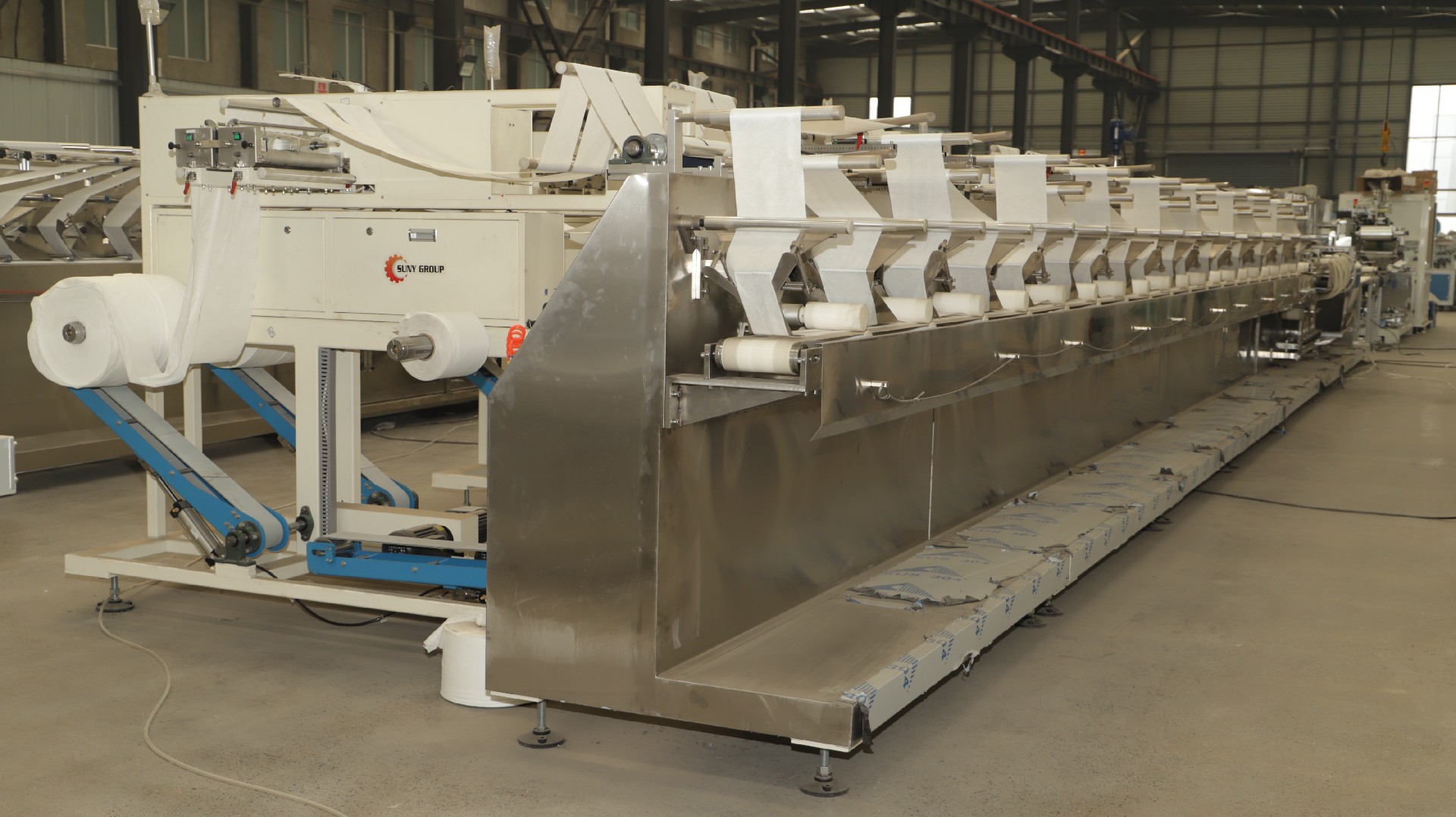
Wet Wipes Processing production line
Wet Wipes Production Process: Step-by-Step
Step 1: Material Preparation
Select appropriate non-woven fabric based on the intended application. Common materials include spunlace (most popular for baby wipes), thermal bond (economical option), and specialized blends for specific applications.
Step 2: Formula Development
Prepare the wetting solution containing water, preservatives, surfactants, fragrances, and active ingredients. The formula varies based on product type and target market requirements.
Step 3: Fabric Feeding and Wetting
The production line automatically unwinds the fabric roll and passes it through the liquid saturation chamber where the solution is uniformly applied under controlled conditions.
Step 4: Folding and Cutting
Saturated fabric undergoes precise folding before being cut into individual wipes. The wet wipes processing production line maintains consistent dimensions and counts throughout this process.
Step 5: Quality Control
Integrated inspection systems monitor moisture content, fold quality, cut precision, and material defects. Automated rejection systems remove non-conforming products.
Step 6: Packaging and Sealing
Wipes are automatically counted, inserted into packaging, and sealed to maintain moisture and prevent contamination. Packaging integrity testing ensures product shelf life.
How to Choose the Right Wet Wipes Production Line
Production Capacity Requirements
Evaluate your production needs carefully. Entry-level wet wipes manufacturing equipment produces 40-60 packs per minute, while high-speed industrial lines achieve 120-200+ packs per minute. Consider both current demand and future growth projections.
Product Versatility
Modern production lines offer flexibility to manufacture different wipe sizes, fold types, and package formats. Multi-functional equipment provides better return on investment for manufacturers serving diverse markets.
Automation Level
Determine the appropriate automation level based on labor costs, production volume, and quality requirements. Fully automated lines minimize manual intervention and ensure consistent product quality.
Quality and Compliance Standards
Ensure the wet wipes making machine meets relevant industry standards including GMP, FDA, and CE certifications. This is particularly important for baby wipes and medical-grade products.
After-Sales Support and Training
Reliable technical support, spare parts availability, and comprehensive operator training are essential factors when selecting equipment suppliers.
Advantages of Modern Wet Wipes Processing Production Lines
Enhanced Production Efficiency
Automated systems significantly increase output while reducing labor costs. Modern production lines operate continuously with minimal downtime, maximizing productivity.
Consistent Product Quality
Computer-controlled processes ensure uniform moisture content, precise dimensions, and consistent fold quality across all products, reducing waste and customer complaints.
Reduced Material Waste
Advanced monitoring and control systems optimize material usage, minimizing waste and improving profit margins. Typical material efficiency exceeds 95% on modern equipment.
Flexibility and Customization
Quick changeover capabilities allow manufacturers to produce multiple product lines on the same equipment, responding rapidly to market demands.
Hygienic Production Environment
Enclosed production systems and stainless steel construction maintain sanitary conditions, essential for baby care and medical products.
Advantages of Modern Wet Wipes Processing Production Lines
Enhanced Production Efficiency
Automated systems significantly increase output while reducing labor costs. Modern production lines operate continuously with minimal downtime, maximizing productivity.
Consistent Product Quality
Computer-controlled processes ensure uniform moisture content, precise dimensions, and consistent fold quality across all products, reducing waste and customer complaints.
Reduced Material Waste
Advanced monitoring and control systems optimize material usage, minimizing waste and improving profit margins. Typical material efficiency exceeds 95% on modern equipment.
Flexibility and Customization
Quick changeover capabilities allow manufacturers to produce multiple product lines on the same equipment, responding rapidly to market demands.
Hygienic Production Environment
Enclosed production systems and stainless steel construction maintain sanitary conditions, essential for baby care and medical products.
Investment Considerations for Wet Wipes Manufacturing
Initial Capital Investment
Entry-level wet wipes processing production lines start around $50,000-$100,000, while fully automated high-speed systems can exceed $500,000. Consider total cost of ownership including installation, training, and maintenance.
Operating Costs
Factor in raw material costs, utilities, labor, maintenance, and quality control expenses. Efficient equipment design minimizes energy consumption and reduces operating costs.
Return on Investment
Calculate expected ROI based on production capacity, market pricing, and operating costs. Most manufacturers achieve payback periods of 18-36 months depending on market conditions.
Future Trends in Wet Wipes Manufacturing
Sustainable and Biodegradable Materials
Growing environmental concerns drive demand for biodegradable non-woven fabrics and eco-friendly formulations. Modern production lines increasingly accommodate these sustainable materials.
Smart Manufacturing Integration
Industry 4.0 technologies including IoT sensors, real-time monitoring, and predictive maintenance enhance production efficiency and reduce downtime.
Customization and Personalization
Advanced wet wipes manufacturing equipment enables small-batch production and customized formulations, meeting the growing demand for specialized products.
Investing in a high-quality wet wipes processing production line is essential for manufacturers seeking to compete in the growing wet wipes market. By understanding the production process, equipment components, and selection criteria, businesses can make informed decisions that maximize efficiency, quality, and profitability.
Whether you're launching a new wet wipes brand or expanding existing production capacity, choosing the right wet wipes making machine and production line configuration will determine your long-term success in this dynamic industry.