The demand for large-pack wet wipes continues to create opportunities for manufacturers in the baby care, personal hygiene, household cleaning, and healthcare markets. To meet these requirements, manufacturers need a reliable wet wipes packing machine that can handle high-count packages while maintaining consistent product quality and packaging efficiency.
Unlike small sachet production equipment, a big pouch wet wipes production line is designed to manufacture multi-piece packs containing 30–160 wipes per bag. The entire process integrates nonwoven fabric feeding, folding, liquid application, cutting, stacking, packaging, sealing, and automatic lid application.
For manufacturers planning to expand their production capacity or enter the large-pack wet wipes market, choosing the right wet wipes machine is essential for improving production efficiency and maintaining stable output.
This article explains how an automatic wet wipes packing machine works, its main production stages, key automation features, and the factors manufacturers should consider when selecting equipment.
1. What Is a Wet Wipes Packing Machine for Large Packs?
A wet wipes packing machine is an automated production system used to convert nonwoven fabric into finished, pre-moistened wet wipes packages.
For large-pack manufacturing, the equipment must handle a higher number of wipes per package while maintaining accurate folding, moisture distribution, counting, and packaging quality.
A big pouch wet wipes production machine is particularly suitable for producing:
- Baby wipes in large resealable packs
- Household cleaning wipes
- Personal care wet wipes
- Disinfectant wipes
- Kitchen cleaning wipes
- Pet cleaning wipes
- Commercial hygiene wipes
Compared with small-package equipment, a large-pack production line requires coordinated operation between the folding, liquid dosing, stacking, packaging, and lid application systems.
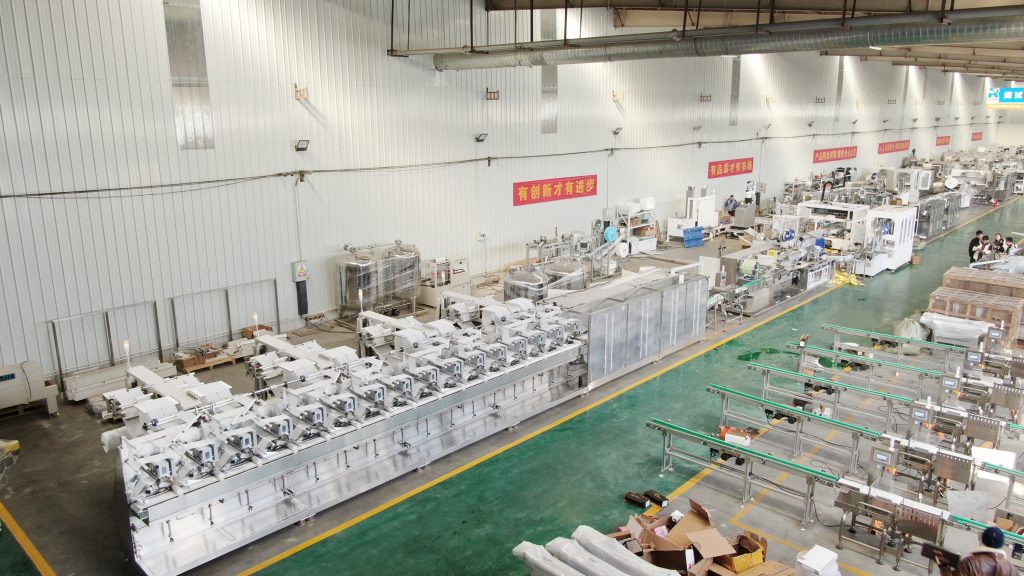
SUNY’s Big Pouch Wet Wipes Production Machine is designed for packages containing 30–160 wipes per bag. It integrates multiple production stages into one fully automatic line, helping manufacturers simplify production management and reduce manual handling.
Learn more about the SUNY Big Pouch Wet Wipes Production Machine.
2. How Does a Big Pouch Wet Wipes Production Line Work?
A modern wet wipes production machine combines several processes into a continuous manufacturing workflow.
The typical production sequence is:
Nonwoven Fabric Feeding → Folding → Liquid Adding → Cutting → Stacking → Packaging → Sealing → Lid Application
Each stage contributes to the quality, consistency, and efficiency of the finished wet wipes.
2.1 Nonwoven Fabric Feeding and Automatic Splicing
The production process begins with nonwoven fabric rolls.
Common materials used in wet wipes manufacturing include spunlace nonwoven fabric, degradable nonwoven materials, hot-rolled nonwoven fabric, and dust-free fabric.
The machine uses a fabric feeding system to transport the material smoothly into the folding section. Stable tension control is important because material deviation or wrinkles can affect the final wipe dimensions and folding quality.
SUNY’s big pouch wet wipes production machine supports:
- Twin-roll fabric feeding
- Automatic material splicing
- Servo-driven constant tension control
- Visual tension monitoring
- Automatic web guiding
The automatic splicing system helps reduce production interruptions during material roll changes, supporting more continuous manufacturing operations.
2.2 Wet Wipes Folding
After fabric feeding, the nonwoven material enters the folding section.
Folding accuracy directly affects the finished wipe dimensions, stacking arrangement, and dispensing experience.
The production line supports two folding methods:
Interfold Folding
Interfold folding allows wipes to be connected in a dispensing arrangement, helping users remove individual wipes conveniently from the package.
Single Extraction Folding
Single extraction folding provides an alternative folding arrangement for products requiring a different dispensing structure.
Manufacturers can select the appropriate folding method according to the finished product design, package structure, and customer requirements.
2.3 Automatic Liquid Adding and Moisture Distribution
Liquid application is another essential stage in wet wipes manufacturing.
After folding, the nonwoven material passes through the liquid application system, where the specified lotion or cleaning solution is added.
For large-pack wet wipes, maintaining consistent moisture distribution throughout the stack is particularly important.
Uneven liquid application may result in some wipes becoming excessively wet while others remain relatively dry.
SUNY’s equipment uses a pre-wetting and layer-dosing system to help distribute liquid across the material.
The machine is also equipped with two 1,000-liter liquid tanks, providing a practical configuration for continuous production.
The liquid formulation and dosage should be determined according to the intended wet wipe application and finished product specifications.
2.4 High-Speed Cutting and Automatic Stacking
Once the fabric has been folded and moistened, it enters the cutting section.
The continuous material is cut into individual wipes according to the required dimensions.
The finished wipes are then transferred to the automatic stacking system.
For large-pack production, accurate stacking is important because each package must contain the specified number of wipes.
SUNY’s big pouch wet wipes production line features a dual-channel stacking design to support continuous operation and efficient product handling.
The equipment specifications include a folding capacity of up to 8,000 wipes per minute and a cutting capacity of up to 400 cuts per minute.
Actual output depends on the wipe dimensions, folding configuration, and production conditions.
2.5 Automatic Packaging and Sealing
After stacking and counting, the wipes are transferred into the packaging section.
The packaging system wraps the finished wipe stacks using suitable flexible packaging materials.
Common packaging options include:
- PET/PE composite film
- PET/ALUPE film
- PET/ALCPP film
- BOPP/PE/ALUPE composite film
The packaging material should provide suitable moisture protection, sealing performance, and compatibility with the finished product design.
The machine supports packaging dimensions of approximately 150–230 mm in length, 100–120 mm in width, and 30–80 mm in height.
Automatic film splicing helps reduce interruptions when packaging film rolls are changed, supporting stable production and reducing material waste.
2.6 Automatic Plastic Lid Application
Large-pack wet wipes commonly use resealable plastic lids to improve convenience and help protect the remaining wipes after opening.
An automatic lid application system positions and attaches the plastic lid to the finished pouch.
SUNY’s big pouch wet wipes machine features a smart lid applicator with a vision-assisted positioning system.
Its main advantages include:
- Accurate lid positioning
- Consistent application quality
- Automatic lid feeding
- Reduced manual handling
- Continuous production support
The specified lid application speed is approximately 70–80 lids per minute, depending on the production configuration.
3. Key Technical Specifications of SUNY Big Pouch Wet Wipes Machine
When evaluating a wet wipes machine, manufacturers should compare production capacity, supported materials, packaging dimensions, automation systems, and utility requirements.
The following table summarizes the main specifications of SUNY’s big pouch wet wipes production machine.
| Parameter | Specification |
|---|---|
| Product format | 30–160 wipes per pack |
| Folding capacity | Up to 8,000 wipes/min |
| Cutting capacity | Up to 400 cuts/min |
| Packing speed | 65–80 bags/min |
| Lid application speed | 70–80 lids/min |
| Folding method | Interfold or single extraction |
| Fabric width | 90–210 mm |
| Maximum fabric roll diameter | 1,100 mm |
| Unfolded wipe size | 110–240 × 90–210 mm |
| Packing dimensions | 150–230 × 100–120 × 30–80 mm |
| Film thickness | 0.07–0.09 mm |
| Control system | PLC + Touch Screen |
| Power supply | AC 380V, 50/60Hz |
| Total power | 41 kW |
| Air pressure | 0.6–0.8 MPa |
| Air consumption | 0.3 m³/min |
| Liquid tank volume | 2 × 1,000 L |
Note: The specifications are based on the machine configuration provided by SUNY. Actual production capacity may vary depending on wipe dimensions, pack count, packaging film, and other operating conditions.
4. Why Choose an Automatic Wet Wipes Packing Machine?
For manufacturers producing high-count wet wipes packages, automation plays an important role in improving production consistency and operational efficiency.
4.1 Higher Production Efficiency
An integrated production line connects fabric feeding, folding, liquid application, cutting, stacking, and packaging.
This coordinated workflow reduces unnecessary manual transfers between production stages and supports continuous manufacturing.
With a specified packing speed of 65–80 bags per minute, SUNY’s big pouch wet wipes machine is designed for manufacturers with substantial production requirements.
4.2 Reduced Material Waste
Nonwoven fabric and packaging film represent important material costs in wet wipes manufacturing.
Automatic splicing, visual tension monitoring, and web guiding help maintain stable material feeding.
The automatic film splicing system also helps reduce unnecessary packaging interruptions during roll changes.
4.3 Consistent Product Quality
Consistent folding, liquid application, counting, and sealing are essential for producing high-quality wet wipes.
Automated production systems help manufacturers maintain more consistent product dimensions, moisture distribution, and package appearance.
4.4 Improved Packaging Appearance
Packaging quality directly influences the presentation of wet wipes products in retail markets.
Accurate sealing and automatic lid application help create neat, convenient, and resealable packages.
This is particularly important for baby wipes, personal care products, and household cleaning wipes sold in large packs.
4.5 Flexible Product Configurations
Different markets require different wipe sizes, package counts, folding arrangements, and packaging materials.
A flexible wet wipes production machine allows manufacturers to adjust equipment configurations according to their product portfolio and market requirements.
SUNY’s big pouch production line supports 30–160 wipes per package, providing flexibility for different large-pack product specifications.
5. What Should Manufacturers Consider Before Buying a Wet Wipes Machine?
Selecting the right wet wipes packing machine requires more than comparing the advertised production speed.
Manufacturers should evaluate several factors before making an investment.
5.1 Required Wipes Per Package
The first consideration is the number of wipes in each finished package.
For example, a manufacturer producing 30, 60, 80, or 160 wipes per pack may have different requirements for stacking, packaging dimensions, and production speed.
Confirm the required pack counts before selecting the machine configuration.
5.2 Wipe Dimensions and Folding Methods
Wipe dimensions influence fabric width, cutting length, folding arrangements, and finished package size.
Manufacturers should provide the required unfolded and folded wipe dimensions to the equipment supplier.
The preferred dispensing method, such as interfold or single extraction, should also be confirmed.
5.3 Packaging Material and Lid Requirements
Packaging materials must be compatible with the machine’s feeding, forming, and sealing systems.
If the finished product requires a resealable plastic lid, manufacturers should also confirm the lid dimensions, feeding method, and application requirements.
5.4 Production Capacity
When evaluating machine output, it is important to distinguish between folding speed, cutting speed, finished packing speed, and actual production output.
A machine may have a high folding capacity, but the number of completed packages per minute depends on the number of wipes in each pack and the overall production configuration.
For accurate project planning, manufacturers should discuss their expected daily or monthly production requirements with the supplier.
5.5 Installation and Technical Support
Equipment investment also involves installation, commissioning, operator training, spare parts, and long-term maintenance.
Choosing a manufacturer that provides technical support throughout the project helps reduce installation risks and improves production readiness.
For more information about SUNY’s equipment solutions and technical support, visit our wet wipes machine services page.
6. Wet Wipes Manufacturing Quality and Industry Standards
Machine performance is only one part of successful wet wipes manufacturing. Raw material selection, liquid formulation, packaging quality, product safety, and labeling also influence the finished product.
According to EDANA’s wet wipes industry information, wet wipes manufacturing involves different fibre materials, product formulations, converting processes, and packaging requirements.
Manufacturers can also consult EDANA’s international standards and testing resources to understand relevant nonwoven material testing practices.
For equipment manufacturers and factory operators, machinery safety should also be considered during equipment selection, installation, and operation. Relevant machinery safety references should be evaluated according to the actual equipment type and applicable market requirements.
For example, ISO 22291:2022 specifies safety requirements for wetlaid-nonwoven machinery. Its scope should not be assumed to cover every type of wet wipes converting or packaging machine.
7. SUNY Big Pouch Wet Wipes Production Machine for Large-Scale Manufacturing
SUNY provides automated wet wipes production equipment for manufacturers serving personal care, baby care, healthcare, and household cleaning markets.
The Big Pouch Wet Wipes Production Machine integrates the main production processes required for high-count wet wipes packages.
Its configuration includes:
- Automatic nonwoven fabric feeding and splicing
- Servo-driven tension control
- Interfold or single extraction folding
- Pre-wetting and layer liquid dosing
- High-speed cutting and dual-channel stacking
- Automatic packaging and film splicing
- Vision-assisted plastic lid application
With support for 30–160 wipes per pack and a specified packing speed of 65–80 bags per minute, this machine is designed to meet the needs of manufacturers planning large-pack wet wipes production.
Whether you are establishing a new wet wipes factory or upgrading an existing production line, SUNY can help evaluate your production requirements and recommend a suitable equipment configuration.
Explore the Big Pouch Wet Wipes Production Machine to learn more about its features and technical specifications.
8. Frequently Asked Questions About Wet Wipes Packing Machines
Q1: What is a wet wipes packing machine used for?
A wet wipes packing machine is used to manufacture and package pre-moistened wipes. Depending on its configuration, the production line can integrate fabric feeding, folding, liquid application, cutting, stacking, packaging, sealing, and lid application.
Q2: How many wipes can a big pouch wet wipes machine produce per package?
SUNY’s big pouch wet wipes production machine supports 30–160 wipes per package. The actual configuration depends on the required wipe dimensions, folding method, and packaging specifications.
Q3: What is the packing speed of SUNY’s big pouch wet wipes machine?
The specified packing speed is approximately 65–80 bags per minute. Actual output depends on the number of wipes per package, packaging material, and operating conditions.
Q4: Does the machine support automatic plastic lid application?
Yes. The production line includes an automatic lid applicator with a vision-assisted positioning system. The specified application speed is approximately 70–80 lids per minute.
Q5: What materials can be used for wet wipes production?
Common materials include spunlace nonwoven fabric, degradable nonwoven materials, hot-rolled nonwoven fabric, and dust-free fabric. The material should be confirmed according to the intended product application and machine configuration.
Q6: Can the machine produce different wet wipes package sizes?
Yes. The machine supports different package counts and adjustable packaging dimensions within its specified operating range. Manufacturers should confirm their required product sizes and packaging materials before ordering.
Q7: How can I get a quotation for a big pouch wet wipes production line?
To receive an accurate quotation, provide the required wipes per package, unfolded wipe dimensions, folding method, packaging material, lid requirements, target production capacity, and destination country.
You can contact SUNY’s engineering and sales team to discuss your project requirements and obtain a suitable equipment proposal.
Conclusion
A reliable wet wipes packing machine is essential for manufacturers producing large-count wet wipes packages for baby care, personal hygiene, household cleaning, and other applications.
By integrating automatic fabric feeding, folding, liquid application, cutting, stacking, packaging, sealing, and lid application, a big pouch wet wipes production line helps manufacturers improve production coordination and maintain consistent finished product quality.
SUNY’s Big Pouch Wet Wipes Production Machine supports 30–160 wipes per package and offers an integrated solution for large-pack wet wipes manufacturing.
Looking for a suitable wet wipes production machine for your factory? Contact SUNY Industrial to discuss your product specifications, production requirements, and customized equipment solutions.