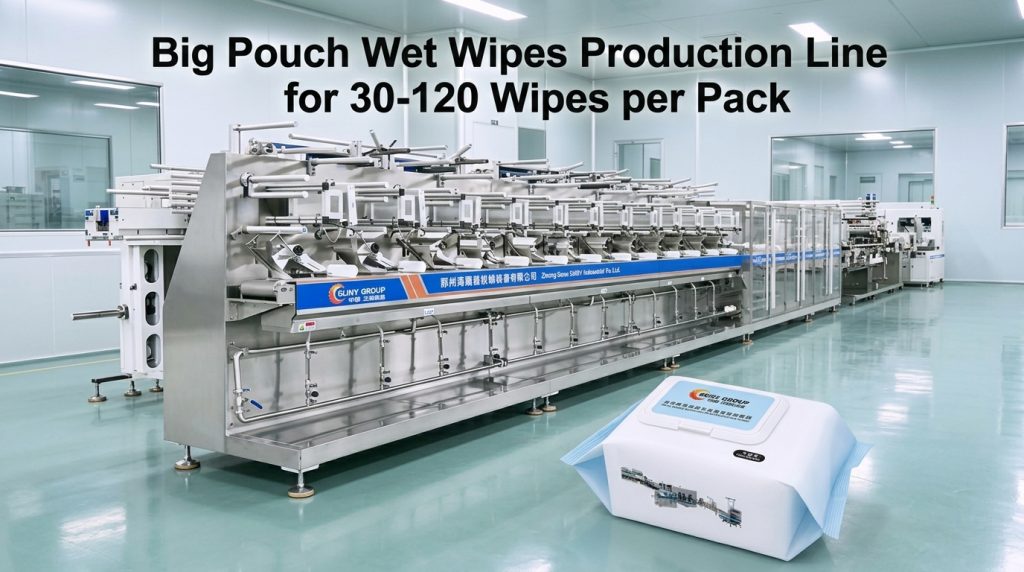
A Big Pouch Wet Wipes Production Line is designed for manufacturers producing large packs of wet wipes for baby care, personal hygiene, household cleaning, and other applications. For businesses looking to manufacture 30-120 wipes per pack, an automated production line can integrate fabric feeding, folding, liquid application, cutting, stacking, packaging, sealing, and lid application into one continuous process.
SUNY’s Big Pouch Wet Wipes Production Machine is designed for large-pack wet wipes production and supports 30-120 wipes per pack, which covers common production requirements from 30 to 120 wipes per pack. The line can reach a folding capacity of up to 8,000 wipes per minute, with a finished packing speed of approximately 65-80 bags per minute, depending on the wipe size, pack count, packaging film, and production configuration.
What Is a Big Pouch Wet Wipes Production Line?
A Big Pouch Wet Wipes Production Line is an automated system used to manufacture and package high-count wet wipes in resealable soft pouches.
Compared with small-pack wet wipes machines, a large pouch production line is designed to handle a higher number of wipes in each package. This makes it suitable for products such as:
- Baby wipes
- Household cleaning wipes
- Personal care wipes
- Disinfectant wipes
- Kitchen cleaning wipes
- Pet wipes
- Commercial cleaning wipes
The production line combines multiple manufacturing processes so that nonwoven fabric can be converted into finished, sealed wet wipe packages with less manual handling.
For manufacturers targeting 30-120 wipes per pack, the machine configuration can be adjusted according to the required wipe dimensions, folding method, liquid formula, packaging material, and final pack size.
How Does the 30-120 Wipes per Pack Production Process Work?
The manufacturing process can be summarized as:
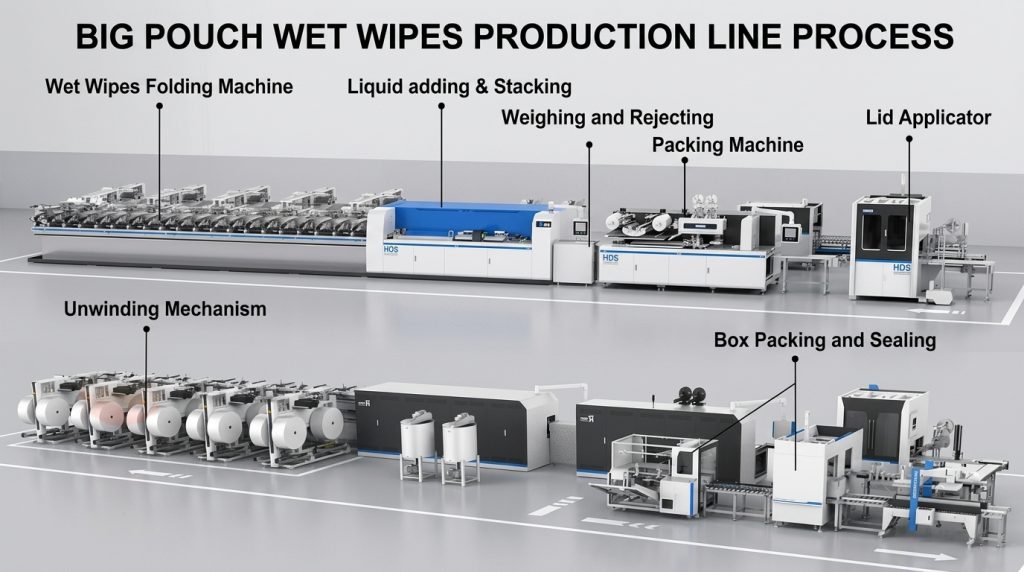
Nonwoven Fabric Feeding → Folding → Liquid Adding → Cutting → Stacking → Packaging → Sealing → Lid Application
Each stage is synchronized to maintain stable production and consistent finished products.
1. Nonwoven Fabric Feeding
The process starts with rolls of nonwoven fabric.
The machine supports materials such as spunlace nonwoven fabric, degradable nonwoven fabric, hot-rolled nonwoven fabric, and dust-free fabric. The maximum fabric roll diameter is 1,100 mm, while the supported fabric width is approximately 90-210 mm.
A twin-roll feeding system with automatic splicing helps reduce production interruptions when changing material rolls.
The system also uses visual tension control and automatic web guiding to keep the fabric aligned during high-speed operation.
2. Folding the Wet Wipes
After feeding, the nonwoven fabric enters the folding section.
The machine supports interfold or single-extraction folding, allowing manufacturers to select a dispensing format according to their product requirements.
The specified unfolded wipe size is approximately 110-240 mm in length and 90-210 mm in width. The folding configuration can then be adjusted to create the required finished wipe dimensions.
Accurate folding is particularly important for large packs because inconsistent folding can affect stacking, dispensing, and the final appearance of the package.
3. Liquid Adding and Moisture Distribution
Liquid application is another important stage of wet wipes manufacturing.
The production line uses pre-wetting and layer dosing to distribute liquid across the wipe material. This helps maintain more consistent moisture throughout the stack.
For manufacturers producing baby wipes, personal care wipes, or household cleaning wipes, the liquid formulation and dosage should be determined according to the intended application and product specifications.
The machine is equipped with two 1,000-liter tanks, while the final liquid system configuration can be adjusted according to the production project.
4. Cutting and Stacking
After folding and liquid application, the continuous nonwoven material is cut into individual wipes.
The production system can achieve a folding capacity of up to 8,000 wipes/min and a cutting capacity of up to 400 cuts/min, depending on the actual configuration.
The individual wipes are then transferred to a stacking system.
A dual-channel stacking design helps maintain continuous production and supports efficient product changeover. The system can count and organize wipes according to the required number per package.
For a 30-120 wipes per pack project, the exact output will depend on the selected wipe size, folding method, and number of wipes in each pouch.
5. Large Pouch Packaging
Once the required number of wipes has been stacked, the stack enters the packaging section.
The Big Pouch Wet Wipes Production Line supports several flexible packaging film structures, including:
- PET/PE
- PET/AUPE
- PET/ALCPP
- BOPP/PE/AUPE
The listed packaging film thickness is approximately 0.07-0.09 mm.
The standard packaging dimensions are approximately:
L150-230 × W100-120 × H30-80 mm
The actual pouch size should be confirmed according to the number of wipes, folded wipe dimensions, film structure, and packaging design.
6. Automatic Sealing
After the film wraps around the stacked wipes, the pouch is formed and sealed.
Stable sealing is important for maintaining the integrity of the package and protecting the moisture of the wipes during storage and transportation.
The automatic film-splicing system allows continuous packaging production while reducing downtime during film roll changes.
According to the current SUNY machine specification, the automatic film-splicing design can minimize packaging waste during roll changes, supporting efficient large-scale production.
7. Automatic Lid Application
Large wet wipes packs commonly use a plastic lid to make the package easier to open and reseal.
The Big Pouch Wet Wipes Production Line includes an automatic lid application system with a specified capacity of 70-80 lids per minute.
The lid applicator uses a vision-assisted system to position lids accurately. This helps improve lid placement consistency and creates a clean, retail-ready package appearance.
For manufacturers producing 30-120 wipes per pack, automatic lid application can also reduce manual packaging operations.
Big Pouch Wet Wipes Production Line Parameters
The following specifications are based on the current SUNY Big Pouch Wet Wipes Production Machine configuration. Actual production performance may vary according to product dimensions, pack count, folding method, packaging film, and other project conditions.
| Parameter | Specification |
|---|---|
| Product format | 30-120 wipes per pack |
| Target application | 30-120 wipes per pack |
| Folding capacity | Up to 8,000 wipes/min |
| Cutting capacity | Up to 400 cuts/min |
| Packing speed | 65-80 bags/min |
| Lid application speed | 70-80 lids/min |
| Fabric width | 90-210 mm |
| Maximum fabric roll diameter | 1,100 mm |
| Unfolded wipe size | L110-240 × W90-210 mm |
| Folded wipe size | L110-240 × W90-110 mm |
| Folding method | Interfold or single extraction |
| Packaging size | L150-230 × W100-120 × H30-80 mm |
| Film thickness | 0.07-0.09 mm |
| Control system | PLC + touch screen |
| Power supply | AC 380 V, 50/60 Hz |
| Total power | 41 kW |
| Air pressure | 0.6-0.8 MPa |
| Air consumption | 0.3 m³/min |
| Tank volume | 2 × 1,000 L |
| Machine dimensions | 26,100 × 3,580 × 2,060 mm |
| Machine weight | Approximately 17,000 kg |
The current SUNY product page confirms the 30-120 wipes/pack operating range and these main technical parameters.
Key Features of the Big Pouch Wet Wipes Production Line
The production line is designed for continuous and automated large-pack wet wipes manufacturing.
Automatic Nonwoven Splicing
The feeding system supports automatic splicing and servo-driven tension control, helping maintain continuous operation when changing fabric rolls.
Visual Tension Control
Real-time tension adjustment helps keep the nonwoven fabric stable and aligned during production.
Automatic Web Guiding
Automatic correction helps prevent material deviation and supports consistent folding and stacking.
High-Speed Cutting
The cutting system supports high-speed production while maintaining consistent wipe dimensions.
Dual-Channel Stacking
Dual-channel stacking helps improve production continuity and allows faster changeovers.
Automatic Film Splicing
Automatic film splicing reduces downtime during packaging material changes and helps minimize packaging waste.
Smart Lid Application
The automatic lid applicator uses vision-assisted positioning to improve the accuracy and consistency of lid placement.
What Products Can Be Made With This Machine?
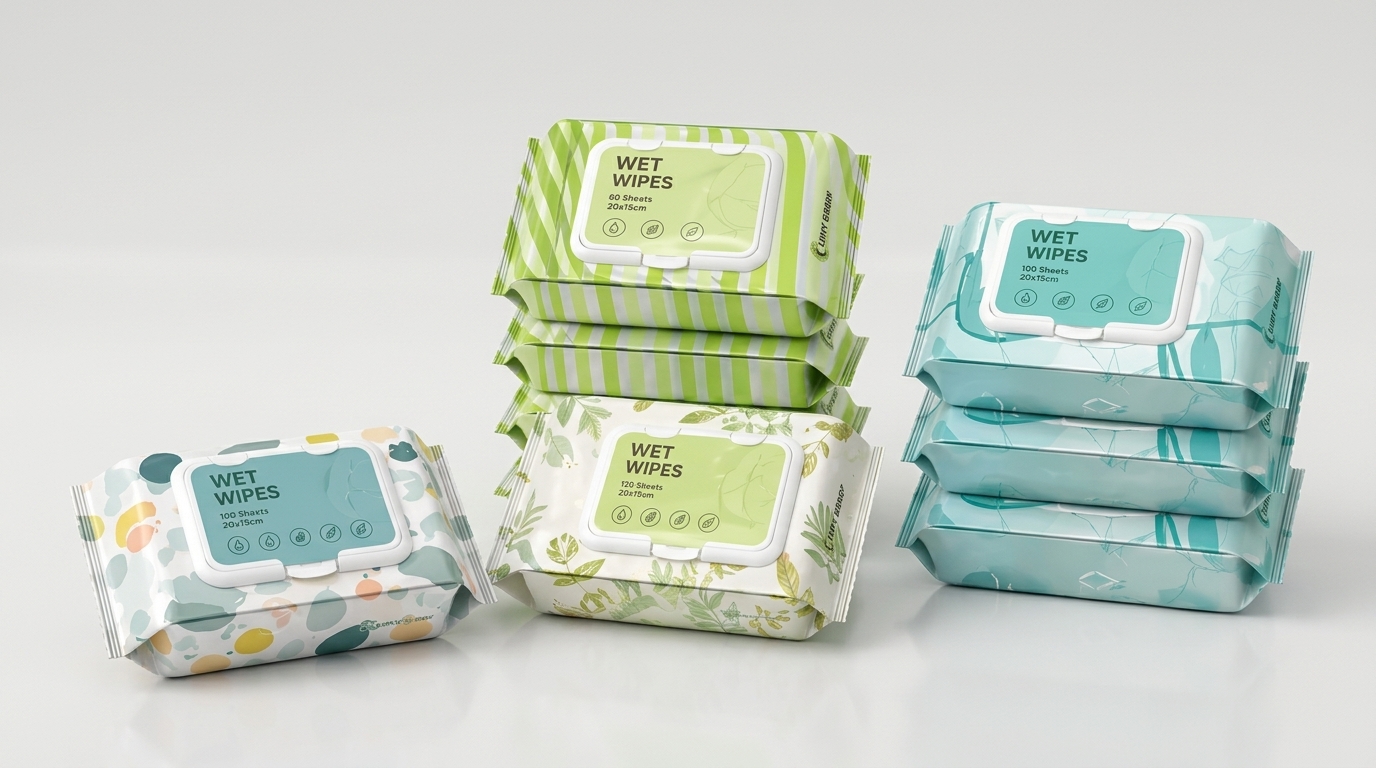
A large-pack wet wipes production line can be configured for different wet wipe applications depending on the selected nonwoven material, liquid formulation, wipe dimensions, and packaging design.
Typical applications include:
Baby Wipes:
Large packs containing 30-120 wipes are commonly used for home and daily baby care.
Household Cleaning Wipes:
High-count pouches are suitable for consumers who need a larger quantity of cleaning wipes.
Personal Care Wipes:
The production line can be configured for different personal hygiene and personal care products.
Disinfectant and Cleaning Wipes:
Specific nonwoven materials and liquid formulations can be selected according to the intended product application and applicable regulations.
Why Choose an Automatic Large-Pack Wet Wipes Line?
For manufacturers producing high-count wet wipes, automation can connect several production stages into a single workflow.
Instead of manually transferring material between folding, liquid application, cutting, counting, stacking, and packaging operations, an integrated line coordinates these processes automatically.
This can help manufacturers achieve:
- More consistent wipe counting
- Stable moisture distribution
- Consistent folding
- Automated pouch packaging
- Reduced manual handling
- Continuous material feeding
- Faster production changeovers
- More consistent finished-product appearance
The exact production efficiency depends on the product specifications and operating conditions. Therefore, manufacturers should select the machine configuration based on their actual production requirements rather than relying only on the maximum machine speed.
How to Choose a 30-120 Wipes per Pack Machine
Before purchasing a Big Pouch Wet Wipes Production Line, manufacturers should confirm several important specifications.
Wipe Dimensions
The unfolded and folded wipe sizes determine the required folding and packaging configuration.
Number of Wipes per Pack
Confirm whether the production plan requires 30, 50, 70, 80, 100, or 120 wipes per pouch. Different pack counts can affect the actual finished-pack output.
Packaging Material
The film structure and thickness should be compatible with the packaging system and the required barrier and sealing performance.
Folding Method
Choose between interfold and single extraction according to the desired consumer dispensing experience.
Lid Requirements
If the finished pouch requires a resealable plastic lid, the lid dimensions and application method should be confirmed during project planning.
Production Capacity
Do not evaluate capacity only by wipes per minute. Finished output is also affected by the number of wipes per pack.
For example, the same production line may produce different numbers of finished bags per minute when configured for 30 wipes per pack compared with 120 wipes per pack.
Conclusion
A Big Pouch Wet Wipes Production Line provides an integrated solution for manufacturers producing high-count wet wipes in large resealable pouches. The system combines nonwoven fabric feeding, folding, liquid application, cutting, stacking, packaging, sealing, and lid application into an automated production process.
SUNY’s current machine supports 30-120 wipes per pack, covering the common 30-120 wipes per pack production range. It offers folding capacity of up to 8,000 wipes per minute, packing speeds of approximately 65-80 bags per minute, and lid application speeds of 70-80 lids per minute, depending on product and packaging specifications.
For a new wet wipes manufacturing project, the final machine configuration should be determined by the required wipe dimensions, number of wipes per pack, folding method, liquid formulation, packaging material, production capacity, and target market.
If you are planning a 30-120 wipes per pack production project, SUNY can evaluate the required configuration according to your product specifications and provide a suitable large-pack wet wipes production solution.