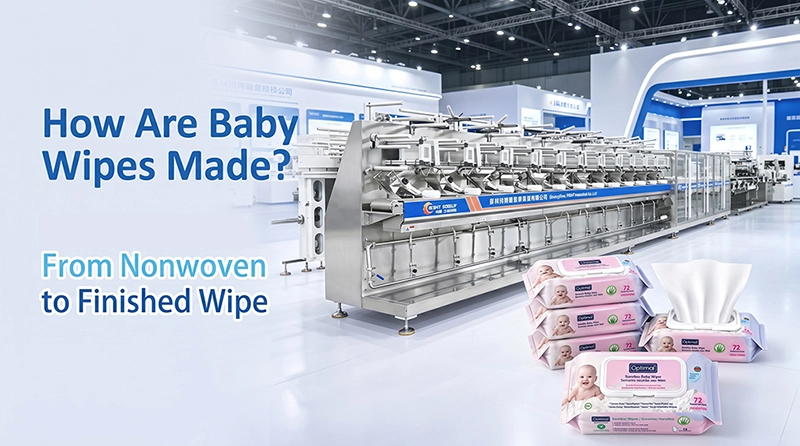
How are baby wipes made? This automated production line handles fabric feeding, folding, liquid application, cutting, stacking and packaging.
Baby wipes may look like a simple everyday hygiene product, but producing them consistently requires a carefully controlled manufacturing process. From the selection of nonwoven fabric to folding, liquid application, cutting, stacking, packaging, sealing, and lid application, every stage affects the quality of the finished wipes.
So, how are baby wipes made?
A modern baby wipes production line can combine these processes into one automated system. For large packs containing 30–160 wipes, the SUNY Big Pouch Wet Wipes Production Machine integrates fabric feeding, folding, liquid adding, cutting, stacking, pouch packaging, sealing, and lid application in a continuous production process.
What Materials Are Baby Wipes Made Of?
The main material used to produce baby wipes is nonwoven fabric. Depending on the product specification, manufacturers can use different types of nonwoven materials.
The SUNY Big Pouch Wet Wipes Production Machine is designed to work with:
- Spunlace nonwoven fabric
- Degradable nonwoven fabric
- Hot-rolled nonwoven fabric
- Dust-free fabric
The machine accepts fabric rolls with a maximum diameter of 1100 mm and fabric widths from 90–210 mm. The standard fabric roller core diameter is 76.2 mm.
The choice of fabric influences the softness, strength, absorbency, texture, and overall user experience of baby wipes. For baby-care products, manufacturers typically need to select a material that matches their product formulation, wipe dimensions, and target market requirements. More information about nonwoven materials and their applications can be found through the INDA, the Association of the Nonwoven Fabrics Industry.
The liquid solution is another important part of the finished wipe. The production system uses pre-wetting and layer dosing to distribute liquid evenly throughout the folded wipes. This helps maintain consistent moisture across the finished pack.
How Are Baby Wipes Made?
The baby wipes manufacturing process can be divided into several major stages:
Nonwoven Fabric Feeding → Folding → Liquid Adding → Cutting → Stacking → Packaging → Sealing → Lid Application → Finished Baby Wipes
Each stage performs a specific function and is synchronized with the following process.
1. Nonwoven Fabric Feeding
The process begins with a large roll of nonwoven fabric.
The fabric roll is installed on the automatic feeding system and gradually unwound into the production line. The Big Pouch Wet Wipes Production Machine supports twin-roll feeding, with 10 axes running and 10 axes on standby, together with automatic splicing.
The machine also uses visual tension control and automatic web guiding. These functions help maintain stable fabric movement and correct deviations during high-speed production.
Stable feeding is particularly important because wrinkles, fabric displacement, or unstable tension can affect subsequent folding and cutting.
2. Folding the Nonwoven Fabric
After feeding, the nonwoven fabric enters the folding section.
The machine supports interfold or single-extraction folding, allowing manufacturers to configure the product according to the required dispensing method. The specified unfolded wipe size is L110–240 × W90–210 mm, while the folded wipe size is L110–240 × W90–110 mm.
The folding system prepares the continuous nonwoven web for cutting and stacking.
Understanding how are baby wipes made also requires looking at how the nonwoven fabric is folded before cutting and stacking. For baby wipes sold in large pouches, consistent folding is important because consumers need to be able to remove individual wipes conveniently from the package.
3. Adding the Wet Wipes Liquid
After or during the folding process, the wipes receive the required liquid solution.
The SUNY machine uses an advanced moistening system based on pre-wetting plus layer dosing. This design helps distribute moisture more evenly through the wipe stack.
The equipment is fitted with two 1000 L tanks, providing a total tank volume of 2000 L.
The actual formulation of baby wipe liquid depends on the manufacturer’s product requirements. The production line is designed to apply the liquid consistently rather than define the formulation itself.
Consistent liquid distribution is essential because excessive moisture can affect packaging and sealing, while insufficient moisture can reduce the intended performance of the finished wipe.
4. Cutting the Wet Wipes
Once the fabric has been folded and moistened, the continuous web is cut into individual wipes.
This step is an important part of how are baby wipes made, because accurate cutting determines the final wipe dimensions.
The specified folding capacity is up to 8000 pieces/min, with up to 400 cuts/min listed in the machine parameters. The machine also uses high-speed flying cutting with adjustable cutting length.
This allows the cutting length to be adjusted according to the required wipe dimensions.
Clean and consistent cutting helps ensure that each finished wipe has the correct size and shape before entering the stacking section.
5. Stacking and Counting the Wipes
After cutting, individual wipes are collected and stacked.
The number of wipes in each package can vary according to the product specification. The Big Pouch Wet Wipes Production Machine is designed for large packs containing 30–160 wipes per bag.
A dual-channel stacking system helps maintain continuous operation and supports faster product changeover.
Accurate stacking is important because the final pack must contain the specified number of wipes. It also helps create a consistent package shape before the stack enters the packaging section.
6. Packaging the Baby Wipes
The stacked wipes are then transferred to the packaging section.
The machine supports several packaging film structures, including:
- PET/PE
- PET/AUPE
- PET/ALCPP
- BOPP/PE/AUPE
The listed film thickness is 0.07–0.09 mm. The film roller diameter is approximately 70–75 mm, while the specified film roll diameter is up to 350 mm with a width of 400 mm.
The packaging system forms the flexible pouch around the stacked wipes before sealing.
For large baby wipe packs, packaging needs to provide adequate protection while also allowing consumers to open and reseal the package conveniently.
7. Sealing the Pouch
After the packaging film has been formed around the wipes, the pouch is sealed.
A stable sealing process helps prevent leakage and protects the moisture level of the wipes during storage and transportation.
The automatic film-splicing system is designed to support continuous production. SUNY specifies an ultra-low-waste packaging process in which automatic film splicing can produce only one defective pack during a film splice.
Reducing packaging waste is particularly valuable for high-volume baby wipes production because packaging film is continuously consumed during operation.
8. Applying the Removable Lid
For large baby wipe packages, a removable lid provides a convenient way to open and reseal the pouch.
The Big Pouch Wet Wipes Production Machine includes an automatic lid applicator with a specified capacity of 70–80 lids/min. The machine uses a smart lid application system with dual robots and a vision system to position the lids accurately.
The standard label size is 35–50 mm, while customized sizes can also be supported. Label thickness is specified at 0.06–0.08 mm, and the standard hole size is 20–40 mm, with customization available.
This final stage gives the baby wipes pouch a finished retail appearance and provides a resealable opening for repeated use.
Baby Wipes Production Line Parameters
These stages explain <strong>how are baby wipes made</strong> on an automated production line, from nonwoven fabric feeding to finished-pack production.
For manufacturers evaluating a large-pack baby wipes production line, the main specifications of the SUNY Big Pouch Wet Wipes Production Machine include:
| Parameter | Specification |
|---|---|
| Product format | 30–160 wipes per pack |
| Folding capacity | Up to 8000 pcs/min |
| Cutting capacity | Up to 400 cuts/min |
| Packing speed | 65–80 bags/min |
| Lid application | 70–80 lids/min |
| Fabric width | 90–210 mm |
| Maximum fabric roll diameter | 1100 mm |
| Unfolded wipe size | L110–240 × W90–210 mm |
| Folded wipe size | L110–240 × W90–110 mm |
| Folding method | Interfold or single extraction |
| Packaging size | L150–230 × W100–120 × H30–80 mm |
| Packaging film thickness | 0.07–0.09 mm |
| Main control | PLC + touch screen |
| Power | AC 380 V, 50/60 Hz, 41 kW |
| Air pressure | 0.6–0.8 MPa |
| Air consumption | 0.3 m³/min |
| Tank volume | 2 × 1000 L |
| Machine dimensions | 26100 × 3580 × 2060 mm |
| Machine weight | 17,000 kg |
These specifications are based on the current SUNY product page. Actual production capacity can vary according to wipe dimensions, number of wipes per pack, folding method, packaging film, and other production conditions.
What Happens to the Wipes After Manufacturing?
After the wipes have been folded, moistened, counted, packed, sealed, and fitted with lids, the finished packs can be inspected before entering storage or distribution.
A properly configured automated line helps maintain consistent wipe dimensions, sheet count, moisture distribution, package sealing, and lid positioning.
For manufacturers producing baby wipes at scale, automation also reduces the number of manual operations required between fabric feeding and finished-pack production.
Why Automation Matters in Baby Wipes Manufacturing
Modern baby wipes manufacturing requires more than simply cutting and wetting nonwoven fabric. The production line needs to coordinate multiple processes at high speed while maintaining consistent material tension, folding, moisture distribution, cutting, stacking, packaging, and sealing.
The SUNY Big Pouch Wet Wipes Production Machine incorporates several automation features designed for continuous production, including automatic fabric splicing, visual tension control, automatic web guiding, pre-wetting and layer dosing, flying cutting, dual-channel stacking, automatic film splicing, and automatic lid application.
The machine uses PLC and touch-screen control, while the operating language can be supplied in Chinese, English, Spanish, or customized according to project requirements.
For manufacturers targeting high-volume baby wipes production, these integrated functions can simplify production management and improve process consistency.
Conclusion
So, how are baby wipes made?
The process starts with suitable nonwoven fabric and continues through automatic feeding, folding, liquid application, cutting, stacking, packaging, sealing, and lid application. For large-pack baby wipes, an integrated production line can combine these operations into a continuous automated system.
SUNY’s Big Pouch Wet Wipes Production Machine is designed for 30–160 wipes per pack, with folding capacity up to 8000 pcs/min, packing speeds of 65–80 bags/min, and lid application speeds of 70–80 lids/min. It supports several nonwoven and packaging materials and uses PLC control with a touch screen for automated operation.
If you are planning a baby wipes manufacturing project, the correct machine configuration should be determined by your wipe material, unfolded wipe size, number of wipes per pack, packaging format, required output, and target market.