Choosing a wet wipes machine is not a speed decision. It is a pack-format decision. Once you know whether you are selling a 1-sheet sachet to a hotel or an 80-sheet lidded tub to a supermarket, the machine type, line layout, utility load and staffing all fall into place. Choose the format first, then the machine — and you will avoid the most common and most expensive mistake in this industry: buying a line that cannot make the packs your customers actually order.
This guide walks through the four main categories of wet wipes making machine, how to convert “packs per minute” into real monthly output, which seven spec-sheet lines actually predict your profit, and what really drives wet wipes machine price.
1. What Does a Wet Wipes Machine Actually Do?
A modern automatic wet wipes machine is a synchronized line of five or six stations. Every one of them can become your bottleneck, so it helps to know what each station is responsible for.
The 6 stages of a wet wipes production line
a) Unwind, splicing and tension control. Large parent rolls of spunlace non-woven fabric are loaded, usually at low height to reduce operator strain. A servo-driven constant-tension system keeps the web stable, while automatic splicing lets an operator join a new roll to the running web without stopping the line. Low-position unwinding and non-stop auto splicing are the difference between 85% and 95%+ uptime.
b) Longitudinal folding. The web is folded lengthwise into the wipe width. Most lines handle both Z-fold and W-fold, with independent guiding, deviation correction and folding modules.
c) Cross cutting. Shear cutting sets the unfolded wipe length. Flying-cut systems that track the web at speed allow cutting length to be adjusted from the HMI without changing gears.
d) Liquid dosing (lotioning). This is where product quality is won or lost. Two approaches are common: immersion and spraying for conventional lines, and pre-wetting plus layer-by-layer dosing on high-end lines, which delivers more even moisture and far less variance in wet pick-up. Check the stated dosing accuracy — a good imported metering pump holds ±0.01 ml.
e) Stacking and counting. Servo stacking groups wipes into the required sheet count per pack. Buffering between stacking and packaging lets both run at full speed instead of chasing each other.
f) Packaging, sealing, lid application and secondary packaging. The stack is wrapped in film, the seal is made, a lid or label is applied, and packs are collated into cartons and cases. Downstream, flow wrappers, cartoning machines, case packers and palletizers complete the turnkey wet wipes production line.
2. Four Types of Wet Wipes Machines (and the Pack Size Each One Serves)
Manufacturers segment wet wipe machines by sheets per pack, because that single number dictates the mechanism.
2.1 Single 4-Side Sealed Sachet Machine (1 sheet)
A single 4-side wet wipes machine forms, fills and four-side seals individual sachets — typically 40–120 bags/min with liquid dosing of 0–5 ml at ±0.01 ml accuracy. Vertical and horizontal fold counts are programmable (up to 10 vertical and 4 horizontal folds), so one machine can produce a compact cosmetic wipe or a larger cleaning wipe. It runs laminated film, paper and aluminium laminate, with hot-melt sealing and a “V” or straight tear notch.
Best for: hotels, restaurants, aviation, medical and promotional packs, single-use alcohol pads, eye-makeup-remover and cooling-wipe sachets. Lowest floor space and power draw of any wet wipes packing machine, and the highest margin per square metre.
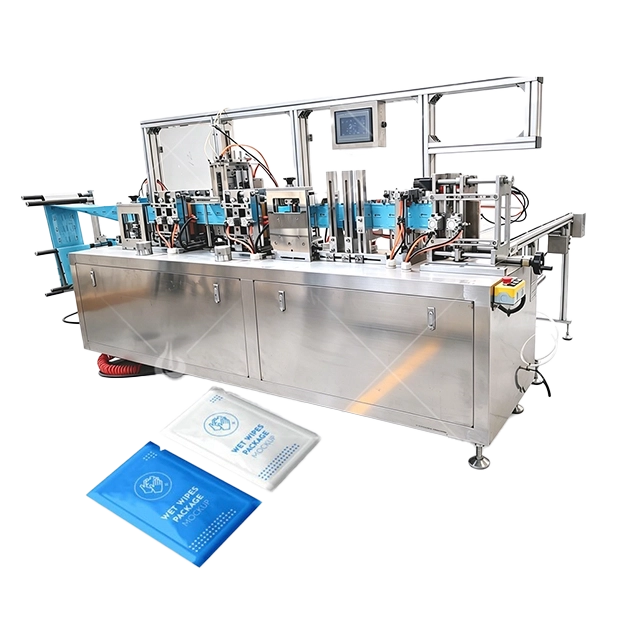
Single 4 Side Wet Wipes Machine
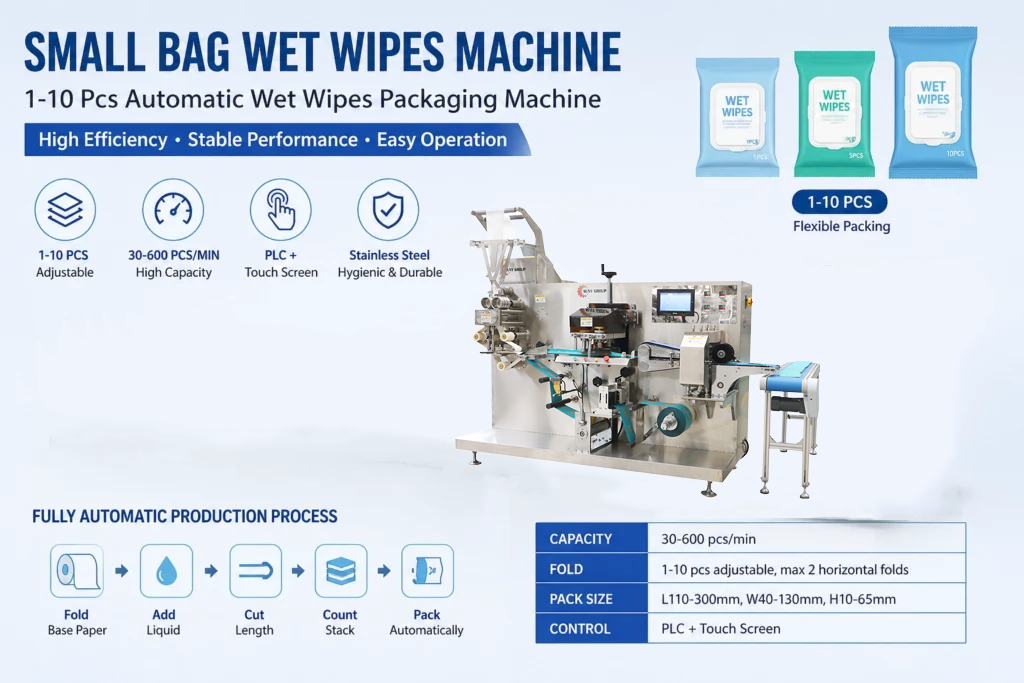
2.2 Small Bag Wet Wipes Machine (1–10 sheets)
A small bag wet wipes machine covers the gap between sachet and travel pack, usually 30–600 sheets/min depending on packing material, with pack sizes from L110–300 × W40–130 × H10–65 mm. Folding and humidification happen in one step with liquid error under 0.01 ml, and punch-hole and labelling can be done inline.
Best for: 4–10 sheet retail multipacks, personal care, baby, and private-label promotional runs where SKU count is high and changeover speed matters more than raw output.
2.3 Portable / Multi-Sheet Pillow Pack Line (5–30 sheets)
A portable wet wipes making machine integrates folding, liquid adding, cutting, stacking and packaging into one line, stacking at 800–1,100 sheets/min and packing at up to 110 packs/min. Dual-axis non-stop splicing, stainless steel cutting with ceramic bearings, and support for flushable and biodegradable substrates are standard on well-built models.
Best for: travel packs, gym and outdoor cooling wipes, in-car packs and the fast-growing “pocket wipe” segment. This is the highest-volume growth format in the market right now.
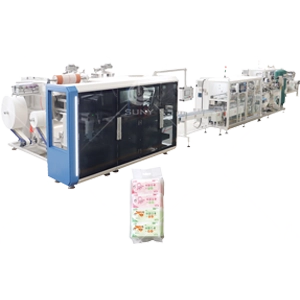
Portable Wet Wipes Making Machine
2.4 Big Pouch Line with Lid Applicator (30–160 sheets)
A big pouch wet wipes production machine is the flagship of the category: up to 8,000 sheets/min and 400 cuts/min, 65–80 packs/min of finished 30–160 sheet pouches, and a 70–80 lids/min applicator driven by dual four-axis robots with vision positioning. Pre-wetting plus layer dosing, auto film splicing that wastes only one pack per splice, and a 4-magazine dual-labeling system for non-stop lid switching all push line efficiency above 95%.
Best for: baby wipes, household cleaning wipes and disinfectant wipes in lidded soft packs — the retail shelf formats where brands pay for consistency and appearance.
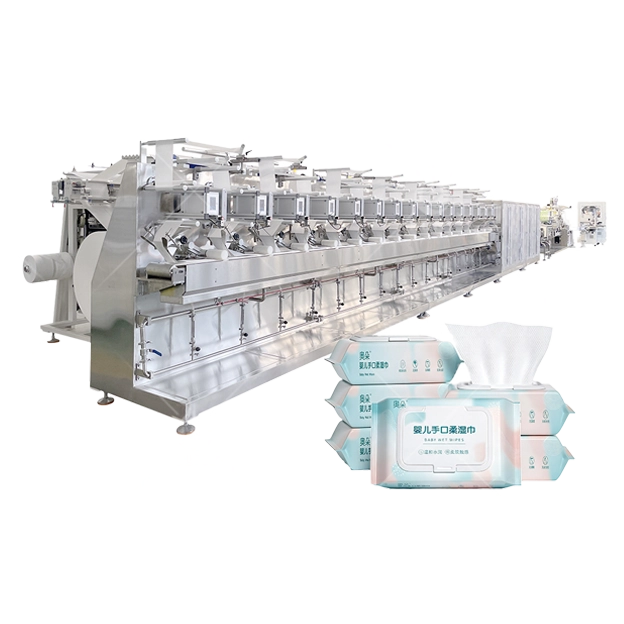
Removable Wet Wipes Making Machine
Comparison table
| Machine type | Sheets per pack | Typical speed | Power | Main market |
|---|---|---|---|---|
| Single 4-side sachet | 1 | 40–120 bags/min | ~4.8 kW | Hotel / medical / promo |
| Small bag | 1–10 | 30–600 sheets/min | ~4.5 kW | Retail multipack |
| Portable / travel | 5–30 | up to 110 packs/min | ~33 kW | Travel, personal care |
| Big pouch with lid | 30–160 | 8,000 sheets/min, 65–80 packs/min | ~41 kW | Baby, household, disinfectant |
3. How to Size Capacity Correctly
Distributors quote three different numbers: sheets/min, cuts/min and packs/min. Conflating them is how buyers end up with a line that is half the size they need.
Do this calculation before you request a quotation:
Monthly output = packs/min × 60 × working hours/day × working days/month × OEEWorked example — a big pouch line at 70 packs/min, two shifts of 8 hours, 24 working days and a realistic OEE of 85%:
70 × 60 × 16 × 24 × 0.85 ≈ 1,370,000 packs per monthAt 80 sheets per pack, that is roughly 110 million wipes a month. If your target is 300,000 packs/month, that line is oversized by four times — capital, energy and labour all wasted. If your target is 3 million, you need four lines or a higher-speed multi-lane converting system.
Always convert to sheet count as well: at 70 packs/min and 80 sheets, the upstream converting section must feed 5,600 sheets/min. A packaging unit rated for 80 packs/min is useless if the folder in front of it can only deliver 3,000. Balance the line, not the individual station.
Then add 20–30% headroom for the SKUs you expect to add in year two, not the ones you run today.
4. Seven Selection Criteria That Matter More Than Rated Speed
1. Material compatibility, especially flushable substrates. Retailers in the EU, US and Japan increasingly demand genuinely flushable or dissoluble wipes. That means your line must handle 100% bamboo, cotton or viscose non-wovens and hydro-entangled flushable materials without jamming or stretching. Verify this physically with your own rolls before you order — a wet wipes machine tuned for heavy spunlace will misbehave on light flushable stock.
2. Liquid dosing accuracy. Wet pick-up variance is the number-one cause of customer returns: dry packs complain, wet packs leak. Look for pre-wetting plus layer-by-layer dosing, and a stated accuracy in the hundredths of a millilitre rather than a percentage.
3. Changeover time. If you run 12 SKUs, a 60-minute changeover costs you twelve hours a month of production — more than most buyers ever budget for. Branded HMI with 20 stored product recipes, electric gusset adjustment and servo size motors turn changeover into a few taps on the screen.
4. Non-stop features. Auto fabric splicing, auto film splicing, multi-magazine lid switching and buffer stacking are what turn a rated speed into an actual one. Ask specifically how many packs are scrapped per film splice; on good lines the answer is one.
5. Sealing integrity and waste rate. Independent temperature control per sealing zone, high-sensitivity colour tracking and adjustable sealing time let you run thin and sustainable films without seal failure. Film cost is often the largest single consumable line item.
6. Footprint, utilities and labour. Confirm total power (41 kW and up on big pouch lines), air consumption, floor length (a lid-equipped big pouch line can exceed 26 m), and how many operators each shift actually needs. Voltage must match your grid, not the exporter’s convenience.
7. Hygiene, cleaning and safety. CIP systems for hands-free cleaning, stainless steel contact parts, metal detection and weight-check rejection matter enormously for medical, baby and food-contact wipes, and increasingly for retail audits.
5. What Drives Wet Wipes Machine Price
Rather than a single number, price is a ladder of configuration choices. Expect the following to move your quotation most:
- Sheets per pack and target output — the biggest factor by far.
- Lid applicator — robots and vision systems add cost but unlock premium retail formats.
- Non-stop splicing (fabric, film, labels) and buffer systems.
- Lane count on high-speed converting sections.
- Servo brand, PLC/HMI brand, metering pump and sensor origin — ask for the component list by name.
- Material flexibility, especially certified flushable handling.
- Automation depth downstream: multi-packer, cartoner, case packer, palletizer, AGV interface.
- Optional QC: metal detection, weight check, vision inspection, date coding.
- Voltage, language, standards and documentation for your market.
A useful discipline: ask every supplier to quote three configurations — minimum viable, recommended, and fully automatic turnkey. Only then can you compare like for like, and only then can you calculate whether the automation premium pays back in avoided labour.
6. Five Costly Mistakes Buyers Make
- Buying speed instead of format. Lock the pack format and retail channel first.
- Ignoring the substrate roadmap. A line that cannot run flushable material in 2026 will be re-sold by 2029.
- Sizing to today’s orders. Add 20–30% capacity headroom and a recipe-programmable HMI.
- Comparing machine price, not installed cost. Freight, installation, commissioning, training, spare parts, utilities, compressed air and water treatment can be significant.
- No sample trial. Ship your film and your fabric to the factory, run your own recipe, and measure seal strength, wet pick-up and dosing variance before you sign.
7. Supplier Vetting Checklist
- Can they supply a complete wet wipes production line — converting, packaging, secondary packaging, case packing and palletizing — from one accountable vendor?
- Do they have reference installations in your region you can visit, with running operators, not just delivered crates?
- What is their service model: on-site engineers, remote/online support, spare-parts stock, response hours?
- Are certifications genuine for your market (CE and third-party inspection reports, with documentation you can hand to an auditor)?
- How long is the engineering team, and can they customize for capacity, product type and factory layout?
- Will they provide operator training and a commissioning protocol with acceptance criteria in the contract?
At SUNY, founded in 2011 as part of SUNY GROUP, we build wet wipes machines, cotton tissue machines, cotton swab machines and packaging equipment, with an engineering service network across 32 cities in China and installations running in more than 120 countries — from a 5–30 sheet portable line in Indonesia to a 6.5-lane high-speed machine in Turkey.
Frequently Asked Questions
What is a wet wipes machine? A wet wipes machine is an integrated production system that unwinds non-woven fabric, folds and cuts it into wipes, adds lotion or water with precise dosing, stacks the sheets to a set count, and packs and seals them into sachets, pillow packs or lidded pouches. High-end lines add lid application, cartoning, case packing and palletizing.
How many types of wet wipes making machine are there? Four main types, classified by sheets per pack: single 4-side sealed sachet machines (1 sheet), small bag machines (1–10), portable or travel-pack lines (5–30) and big pouch lines with lid applicators (30–160). Alcohol prep pad machines form a separate medical-grade category.
How fast is an automatic wet wipes machine? Typical finished-pack rates run from 40–120 bags/min on single-sachet machines, up to 110 packs/min on travel-pack lines, and 65–80 packs/min of 30–160 sheet pouches on a big-pouch line converting up to 8,000 sheets/min. Real output also depends on film, sheet count and OEE.
Can one wet wipes machine run flushable or biodegradable fabric? Yes, if specified. Look for a line rated for dissoluble and flushable substrates — 100% bamboo, cotton or viscose — with low-tension servo unwinding and gentle stacking, and test it with your own material before ordering.
What is the difference between a wet wipes machine and a wet wipes production line? A machine usually refers to the converting-plus-packaging unit. A production line includes downstream stations — multi-packaging, cartoning, case packing and palletizing — plus utilities, water treatment and lotion preparation, delivered as a turnkey installation.
How do I get an accurate wet wipes machine price? Send the supplier four things: pack format and sheet count, unfolded wipe size, target monthly output, and the non-woven and film materials you intend to run. Those four determine the configuration, and the configuration determines the price.
Do you provide installation and training? Yes. Full automatic wet wipes lines are delivered with on-site installation, commissioning and operator training, backed by real-time online technical support and long-term spare-parts supply.
Choose the Format First. The Machine Follows.
If you tell us your target pack — sachet, travel pack, or lidded pouch — the sheet count, the film you plan to run, and the monthly volume you need to hit, we will size the wet wipes machine and the full production line around it, with a component list, layout drawing and ROI you can take to your board.
Request a quote or chat with our engineers on WhatsApp: +86 18937107672.